


Holland Scherm specializes in noise-reducing solutions along roads, railways, and industrial areas. Commissioned by governments and developers, the company realizes innovative screens that reduce noise pollution and contribute to a healthy living environment. A current example is the noise barrier they are building along the A28 near the new Harderweide residential area near Harderwijk.
Noise barrier for a healthy living environment
The noise barrier is part of the Harderweide area development and is being realized on behalf of the municipality of Harderwijk. The goal: to reduce traffic noise and create a pleasant, quiet living environment for current and future residents.
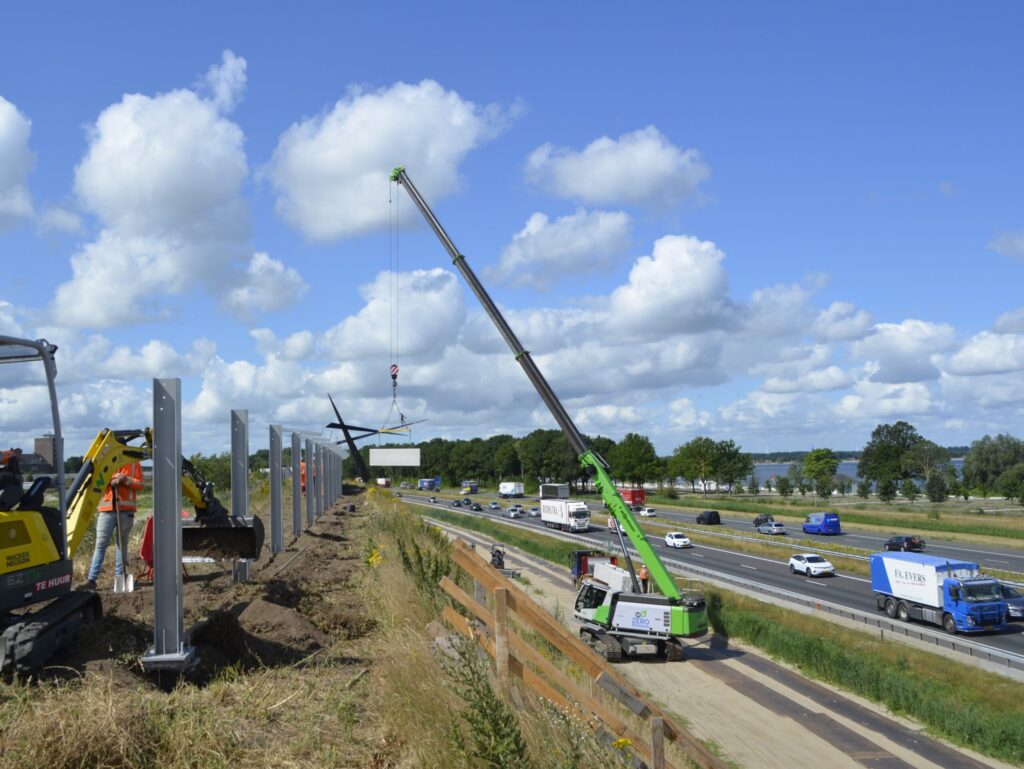
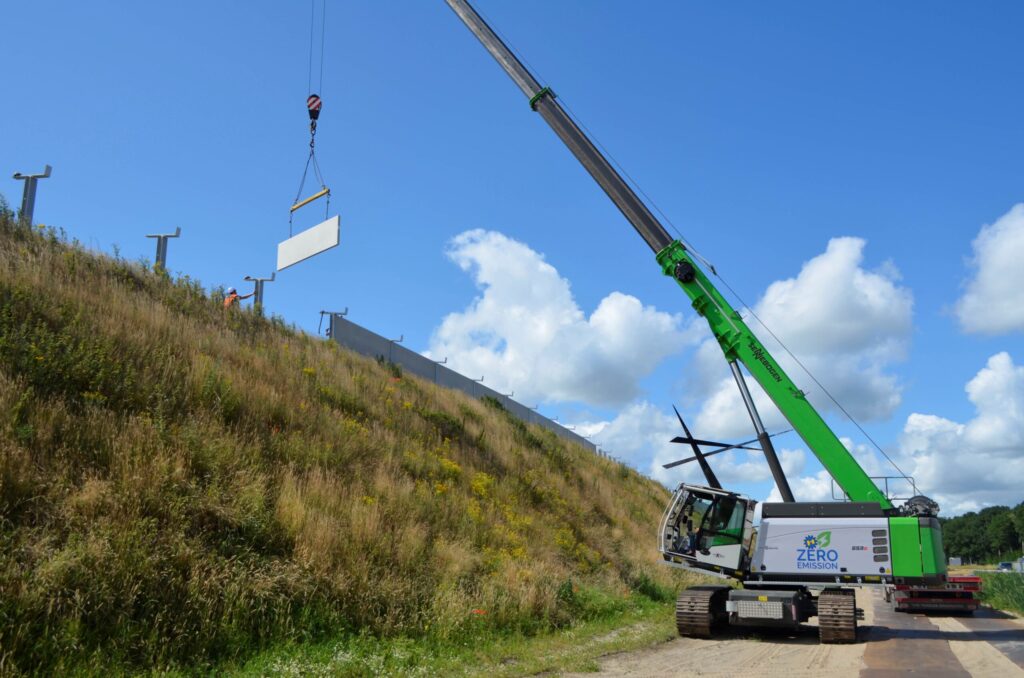
The approach is progressive. It involves working with prefabricated concrete panels, which are quickly and efficiently put in place. Part of the screen stands on an eight-meter-high embankment, the other part on ground level. In total, 880 concrete screen panels and 100 glass panels will be installed. The panels weigh approximately 770 kg each. On top of the screen, a WHIS-top sound diffractor will be placed over the entire length, allowing the screen height to remain two meters lower. A sound diffractor is a special profile that deflects sound waves and therefore offers the same noise reduction as a two-meter-higher screen, but without the extra height.
Building completely emission-free
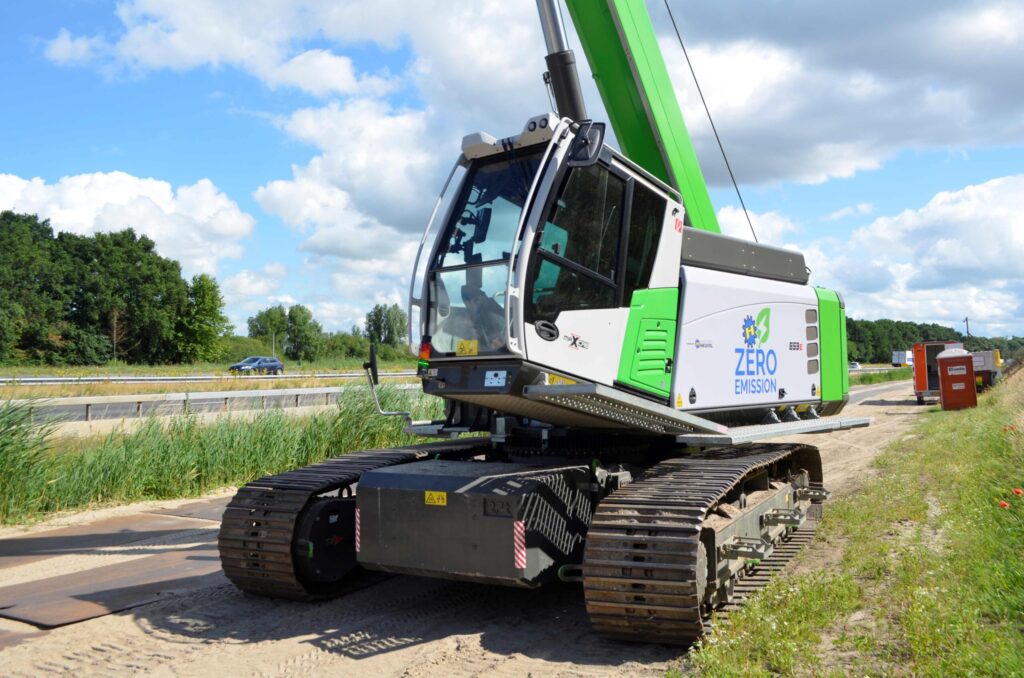
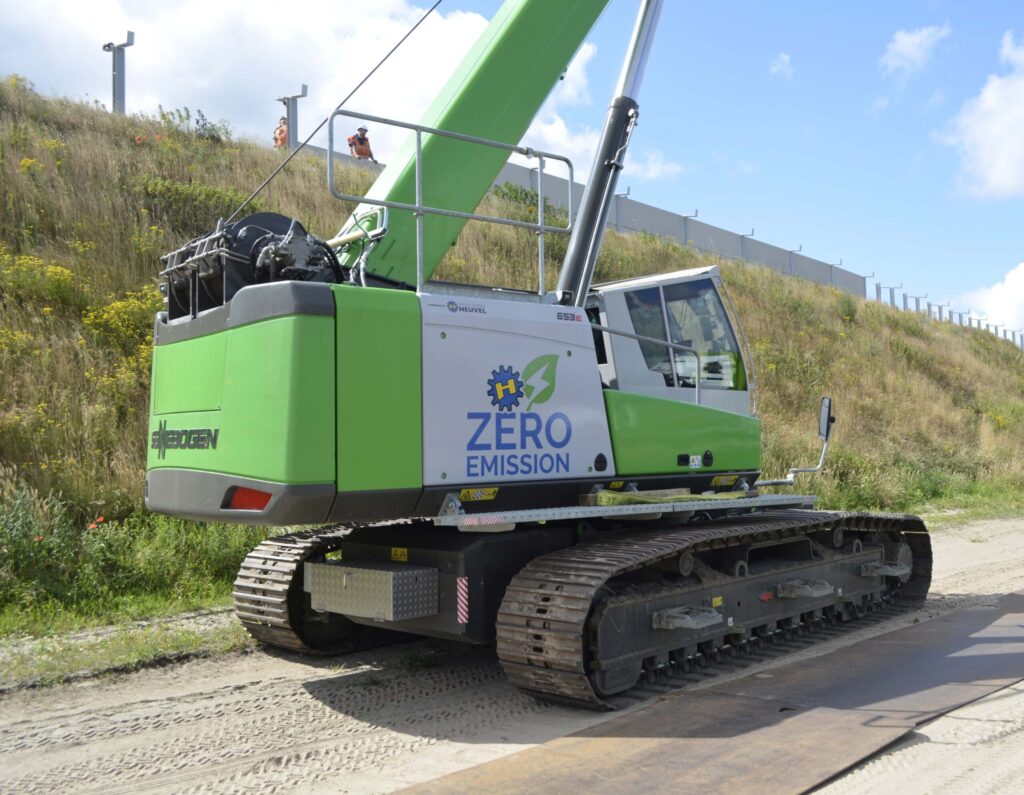
Due to its location next to the Wolderwijd – a Natura 2000 area – a nitrogen and CO₂-free execution was essential. That is why Holland Scherm consciously chose emission-free equipment, including the electric Sennebogen 653 crawler telescopic crane. This crane is used for lifting and positioning steel columns, concrete panels, glass panels and WHIS-top elements. Thanks to its pick-and-carry capacity, the machine is ideal for the elongated and narrow work site along the A28.
Experience in practice
The first experiences with the electric crane are positive. “The machine is good: it works quietly and without noise pollution. Moreover, we can go two days on a full battery. Fast charging is a real advantage,” says Jan Willem Post, foreman at Holland Scherm.
The choice for this crane was partly determined by the reach. “Initially, we considered an electric telehandler, but it did not reach the required distance. Thanks to the reach of the Sennebogen crane, we were able to lay the track plates further from the embankment. The crane has more than enough overcapacity and that just works better.”
Outlook: more electric equipment
The investment in this electric crane fits within Holland Scherm’s broader sustainability strategy. “We expect to use electric cranes more often in the future, provided this fits within the wishes of our clients. Although the crane is more expensive than a comparable diesel variant, it fits perfectly with our ambition to build emission-free.”
Collaboration
According to Holland Scherm, the collaboration with Van den Heuvel went smoothly. “Good guidance and clear instructions. So far there are no additional wishes: everything is going to satisfaction.”
The project on the A28 near Harderweide shows how technical expertise, smart equipment choices and sustainable ambitions come together in practice. By opting for prefab construction and completely emission-free equipment, Holland Scherm demonstrates that efficient construction and care for the environment can go hand in hand perfectly.